4d - Evaluating the Impact of Healthcare Providers' Attitudes and Practices on the Prioritization of Patients with Recent HIV Infections on the Yield of HIV Testing Services in Rwanda

Poster tour posters

Information

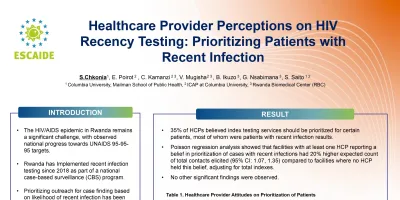
Background : The HIV/AIDS epidemic in Rwanda remains a significant challenge, with observed national progress towards UNAIDS 95-95-95 targets. The case-based surveillance program, featuring recent infection testing, seeks to enhance identification of HIV cases. This study aimed to examine the impact of healthcare provider (HCP) attitudes and practices on prioritizing recent infection cases on contact yield in Rwandan healthcare facilities. 

Methods : Data from 60 facilities in Rwanda were collected by ICAP at Columbia University. HCP attitudes and practices were assessed using self-administered questionnaires, and their impact on total contacts elicited per facility was evaluated. HCP demographics were assessed as covariates. The total of HIV-positive cases enrolled in index testing was assessed as a covariate and an effect measure modifier. Poisson regression and negative binomial regression was used due to overdispersion in count data. Statistical analyses were conducted with R Studio. 

Results : 35% of HCPs believed index testing services should be prioritized for certain patients, most of whom were patients with recent results. Poisson regression analysis showed that facilities with at least one HCP reporting a belief in prioritization of cases with recent infections had 20% higher expected count of total contacts elicited (95% CI: 1.07, 1.35) compared to facilities where no HCP held this belief, adjusting for total indexes. No other significant findings were observed. 

Conclusions The significant findings imply that HCP attitudes may influence contact yield and impact HIV prevention strategies, pointing to interventions emphasizing the prioritization recent infection cases for triage and contact elicitation. However, there was a lack of significant findings in the negative binomial regression models. Future studies should consider a larger sample size, explore additional covariates, and a longitudinal study design to establish causal relationships. 

Disease groups
HIV, sexually transmitted infections and viral hepatitis
Health functions
Surveillance
Keywords
HIV,Surveillance,Health Personnel,Rwanda

Sessions

Poster tour
HIV intervention strategies

Authors

Author
Sophia Chkonia
Co-authors
S. Chkonia(1), E. Poirot(2), V. Mugisha(3), C. Kamanzi(4), B. Ikuzo(5), G. Nsabimana(6), S. Saito(7)
Affiliations
(1)Columbia University, Mailman School of Public Health (2,3,4,7)ICAP at Columbia University (5,6)Rwanda Biomedical Center (RBC)

Sessions

Join the event!

See all the content and easy-to-use features by logging in or registering!