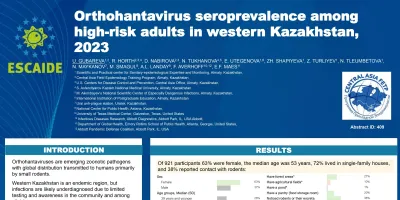
3d - Orthohantavirus seroprevalence among high-risk adults in western Kazakhstan, 2023
Poster tour posters
Information
Background : Orthohantaviruses are emerging zoonotic pathogens with global distribution transmitted to humans primarily by small rodents. Western Kazakhstan is an endemic region, but infections are likely underdiagnosed due to limited testing and awareness in the community and among clinicians. We aimed to estimate antibody seroprevalence and identify associated factors.
Methods : Using a cross-sectional design, we systematically sampled adults living in 14 villages in two endemic districts of Western Kazakhstan in June-July 2023. Investigators interviewed consenting participants and drew blood for orthohantavirus-specific IgG antibody and serotype testing. Poisson regression was used to estimate prevalence ratios (PR) for factors associated with orthohantavirus antibodies.
Results : Among 921 participants, 63% were female, median age was 53 years, 72% resided in single-family houses, and 38% encountered with rodents. IgG antibody seroprevalence was 3.1% (95% confidence interval [CI]: 2.1-4.3). Among seropositive samples (n=28), 18 (64%) were consistent with Puumala orthohantavirus. Cross-reactivity with multiple orthohantavirus was observed in 12 (43%) samples, including one reactive for Hantaan and Dobrava-Belgrade viruses. Among seropositive participants, none reported a history of hantavirus diagnosis or had hantavirus-consistent illness in the past year. Seropositivity was associated with having a blue-collar job (PR=4.1, 95%CI=1.0–27.5), observing rodent activity indoors in the past year (PR=7.3, 95%CI=1.3–53.5), and living near a pond, which is an important rodent habitats (PR=11.5, 95%CI=1.6–54.7). Regular use of gloves for outdoor work was associated with reduced likelihood of seropositivity (PR=0.4, 95%CI=0.2–1.0)
Conclusions We document that hantavirus infection is underdiagnosed in western Kazakhstan. Additional community and clinician awareness of hantavirus may improve routine case detection. Infection was associated with rodent activity and habitats, highlighting the importance of rodent control and precautions to reduce risk of hantavirus exposure.