3c - Five autochthonous dengue cases and the first local transmission in the Paris region in 2023
Poster tour posters
Information
Background : Aedes albopictus, a mosquito vector for dengue, was detected in Île-de-France (IdF: Paris and Greater Paris area) in 2015. It has since continuously expanded in the region, which, associated with population movements to and from dengue-endemic areas, results in an increasing risk of local transmission.
Methods : Dengue is a mandatory notifiable disease year-round in mainland France. Autochthonous cases are those that develop signs with no travel history or 15 days after traveling. Active case finding aims to identify other cases and determines the extent of autochthonous transmission and control efforts.
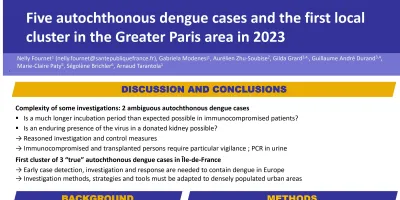
Results : In 2023, 5 autochthonous dengue cases were identified in IdF.A case suffered from homozygous sickle-cell disease, received multiple blood transfusions and kidney transplantation in 2020. He returned from Martinique 37 days before disease onset and had positive RT-PCR. It was impossible to conclude whether this fatal infection was acquired locally or imported.Another case presented fever 5 days following kidney transplantation, tested positive DENV-2 PCR and died 10 days later. Investigation found that the kidney donor returned from Martinique one month earlier, had a negative PCR on graft biopsy but positive IgM/IgG serology.Lastly, a family cluster of three confirmed dengue cases following autochthonous mosquito transmission with no travel history was detected in October 2023.
Conclusions The first two cases illustrate the complexity of some investigations and suggest that a much longer incubation period than expected and a longer presence of the virus in the kidney of an imported donor are possible. The locally acquired cluster was the northernmost vectorial transmission of dengue in Europe. Immunocompromised and transplanted persons require particular vigilance. Early case detection, investigation and response are needed to contain dengue in Europe.