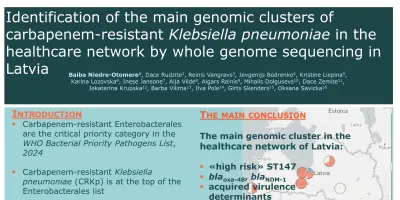
1c - Identification of the main genomic clusters of carbapenem-resistant Klebsiella pneumoniae in the healthcare network by whole genome sequencing in Latvia
Poster tour posters
Information
Background : The threat to the healthcare of carbapenem-resistant Klebsiella pneumoniae (CRKp) is amplified by the spread of convergent strains with acquired virulence determinants. Reports on carbapenem-resistance, convergence and genomic epidemiology of K. pneumoniae from the healthcare network in Latvia have been lacking. Submission of CRKp to the National Microbiology Reference Laboratory is mandatory. We used whole-genome sequencing (WGS) to identify genomic clusters, carbapenemases and convergence.
Methods : We conducted a WGS-based retrospective study of 295 CRKp submitted from 9 laboratories covering 15 healthcare facilities from May 2022 to June 2023, matched with the isolation site, collection date and patient records. Clusters were identified by core genome multilocus sequence typing with maximal pairwise allelic difference (cgMLSTdmax) of 20. Sequence type (ST), capsular antigen locus (KL) type, carbapenemases and convergence were determined by Klebsiella spp. specific genotyping tool.
Results : We identified a major cluster (91 cases; 108 isolates; cgMLSTdmax 20) of ST147 (KL64) spanning 11 healthcare facilities, most isolates (n=84) sustained CRKp spread in the Central tertiary care hospital 1. Majority co-produced carbapenemases OXA-48 and NDM-1 (n=72) and were convergent (n=105). The other cluster (30 cases; 32 isolates; cgMLSTdmax 17) of the non-convergent OXA-48 producer ST219 (KL114) was shared between the Central tertiary care hospitals 1 and 2.The introduction of the non-convergent KPC-3 producer ST512 (KL107) in the Central hospital 1 in March 2023 by migration from Ukraine advanced to establishment (27 cases; 29 isolates; cgMLSTdmax 7), one case from the Central hospital 2 had a preceding hospitalisation at the Central hospital 1 overlapping the introduction.
Conclusions WGS spotted the genomic clusters in the healthcare network, including the migration-introduced source-isolate. The study has established a ground for continuing the genomic surveillance.